I am absolutely not saying SEO is dead. If someone is trying to sell you on that, I would suggest keeping hold of your money.
What I am saying is that it's pointless arguing over SEO vs AEO (or GEO, whatever) - AEO will become the default, and it enhances SEO.
We need everything in SEO for AEO to work.
And I don't know about you but I find that pretty exciting.
We still get to do the technical work, understand customers, build useful websites and make interesting content. We also get a whole new set of problems to solve, with tools that can take away some of the tedious work 15+ years in SEO means I have done a million times already.
These are my thoughts on where we are at with AEO. I've tried to keep it brief enough, but I've got a lot on my mind here, and the last article I wrote on the subject was in November 2025. As with most of my writing, some of this is my own opinion, and some is learning from many other great voices in the industry, as we should.
I hope this is as useful to brand leaders as it is to peers.
If you are new to the mechanics, start with the grounding and retrieval explanation in How to do SEO for AI Search Engines. This article builds on that introduction, with a couple of updates to the earlier simplifications.
My opinion: we should be excited the job is changing
The acronym is the least interesting part
SEO, AEO, GEO, AI SEO. You could argue there are reasonable distinctions between these terms, but I don't think the customer particularly cares.
They want to find something, understand something or get something done.
I am using AEO here because it describes the shift towards answers quite well. It isn't a claim that every search has become a conversation, or that the entire SEO discipline has been replaced. If you prefer to call this an extension of SEO, that is fair. I broadly agree.
We can acknowledge that the foundations are familiar whilst accepting that the interfaces, the measurement and the way we do the work are changing quite substantially.
Google still matters. Of course it does
For most brands, I would still plan on traditional search sending more search traffic than standalone AI assistants in the near term. Check your own numbers before shifting budgets around.
Similarweb's September 2026 analysis of AI referrals describes them as a low single-digit share of total traffic for most sites, despite strong growth. This is evidence of scale and direction, not a reading of every business; but it's for sure important to acknowledge that AEO is not some miracle growth engine right now.
Also, traffic share is not the same as influence. Someone can use an assistant to make a shortlist, then convert elsewhere.
And Google itself has AI search experiences. “Google versus AI” is already an awkward way of dividing up the market.
The bigger change is how people use computers
Think about the difference between these two simple requests:
“Find me some software for managing staff expenses.”
“Compare staff expense tools for our team of sixteen, check which ones work with our existing systems, estimate the cost and prepare a recommendation.”
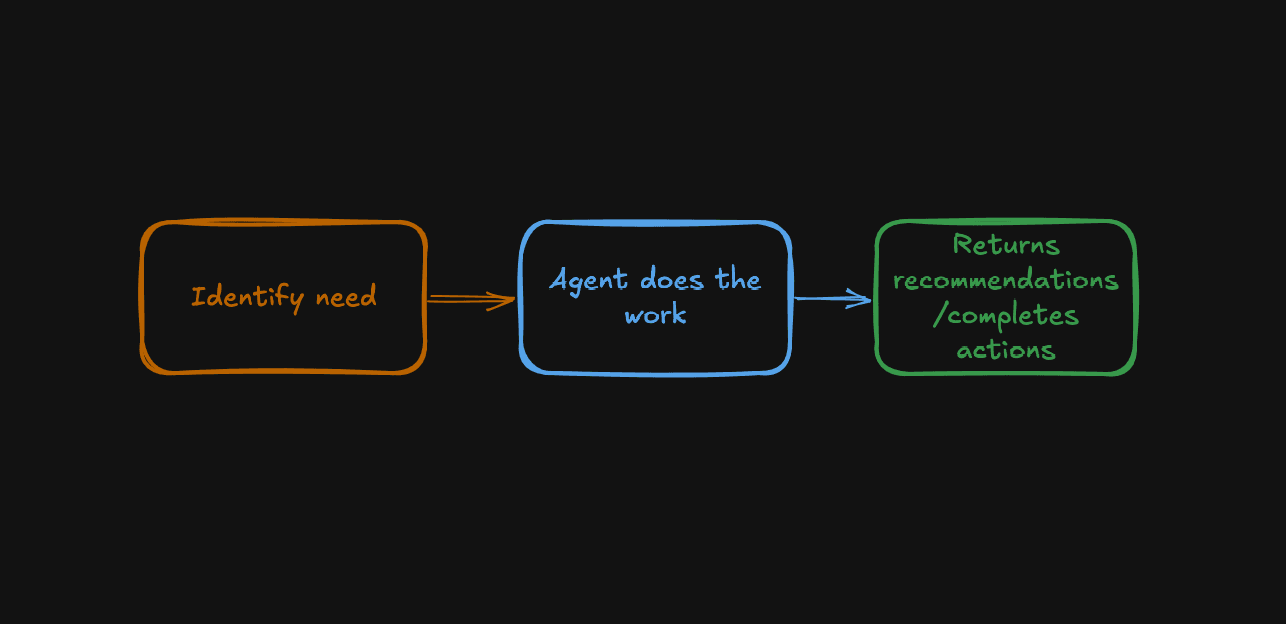
The second is a job, it contains searches, but the person doesn't necessarily want to perform searches themselves.
This is why products like Grok Bot, I believe are going to start to shift search even more. The product is presented as persistent agents with their 'own computer', working across existing tools and taking on tasks through a familiar conversation. But I think it's real power lies in the absolute ease of having multiple agents work alongside you.
Most AI offerings are moving away from AI Chats to Agents.
If you work in tech or marketing, you may already be getting computers to perform tasks for you, and are probably familiar with my points. But with vast improvements in things like Siri and Gemini, everything is moving towards this, not just work, and agents will become something 'regular' (read: people who don't get excited about tech) people are using. And searching with.
As a millennial born in a decade without the internet, the thought of getting a computer to do something like research a holiday destination without me looking through a bunch of websites myself seems mad, but when an agent can return clear results; it just makes sense.

For a lot of searches, that's going to be it.
I would quite like to stop manually matching redirect URLs
I enjoy doing technical SEO.
But I don't think the most valuable use of an experienced SEO's time is manually matching thousands of old URLs to new ones when much of the first pass can be automated.
An agent can help collect the inputs, compare page topics, propose matches and flag uncertain cases. An experienced person still needs to decide whether a destination preserves intent, whether a page deserves a replacement, and whether the whole thing makes commercial sense.
That distinction is where the opportunity sits. We can spend more time on the decisions that need experience, and less time moving information between tools.
Wil Reynolds' piece on automating analytics work explores a related change: what happens when a marketing leader can investigate questions without waiting for someone to produce a report. Truly good SEOs have always shown value in being the ones who don't just deliver the report.
We now have more problems worth solving, and more ways to solve them. With all the AI doom and gloom, I find that quite motivating.
What is new with AEO: a practical strategy for a brand
1. Map customer decisions, then build a prompt library
Keep your keyword research. It is still useful evidence of demand and language.
Alongside it, build a record of the decisions people need help making. Sales conversations, support tickets, site search, customer interviews and lost-deal notes are good places to look.
Imagine a UK company selling customer support software. “Best helpdesk” is useful to know about, but these situations tell us much more:
- A founder choosing the first support tool for a small team.
- An operations manager replacing a tool that has become too expensive.
- A technical lead checking whether an integration handles their actual workflow.
- A buyer deciding whether migration effort outweighs the savings.
Those situations require different evidence. A generic features page probably won't answer all of them.
Andy Chadwick's great article on customer personas and LLM tracking is useful here. His tests illustrate how changing the buyer's context can change the recommendations, even when the basic question stays the same. He also explains why a single answer is a poor basis for a visibility claim.
The implication is to test for identifiable customer groups and repeat the observations. A blank-session prompt is one view of your market, rather than a reproduction of every customer's personalised experience.
For our helpdesk example, I would start with a manageable set of buying situations, questions and constraints. Record the platform, date, market, language and whether search was actually used. Keep the original answers and sources so someone else can review the findings.
If an assistant explains why it selected a brand, treat that explanation as a research lead. It is generated text, not a reliable inspection of the system's internal ranking process. Follow the cited evidence and check with customers before turning it into a content brief.
Your first deliverable should be a useful picture of customer decisions, with a repeatable way to observe them.
2. Understand how an answer gets assembled
The simplified journey is:
A person asks a question → the system interprets the need → it may retrieve information → it selects evidence → it produces an answer, and sometimes takes an action.
These are separate opportunities to succeed or fail.
A page can be accessible but never retrieved. It can be retrieved but not used. It can be cited without your brand being recommended. An assistant can recommend your product whilst linking to a review on someone else's website.
Not every answer uses a fresh web search, either. A system may rely on information learned during training, conversation context, connected private sources or cached material. Getting cited today is not the same thing as being incorporated into model training.
Google describes how its AI features can use query fan-out: multiple related searches across subtopics and sources to help develop an answer. One customer question can therefore create several opportunities for useful supporting information.
For the helpdesk buyer, those might include integration documentation, migration instructions, pricing, independent reviews and cancellation terms. The strategy is to cover the real decision well. Creating a separate thin page for every imagined subquery would miss the point entirely.
3. Stop assuming Google or Bing visibility tells the whole story
My earlier AI search article emphasised Google and Bing as sources for retrieval. They still matter, but that is no longer a sufficient description of the system.
Peec AI's recent investigation, reports evidence of OpenAI's own retrieval infrastructure, including an index family referred to as “Labrador”, alongside external providers and cached pages.
The useful strategic conclusion is narrower: being indexed in Bing or ranking well in Google is not a complete test of ChatGPT visibility. It's safe to assume that a company like OpenAI is probably trying hard to be less dependent on Google.
For most brands, practically, this simply means preparing for the future by investing in AEO tactics.
4. Audit access for the systems you actually want to reach
This is where my technical SEO bias becomes quite obvious.
Before commissioning another article, establish whether the important information on your website can actually be fetched and read.
I would review:
- Discovery: important URLs linked from relevant pages, sensible sitemaps and no orphaned commercial content.
- Responses: working status codes, useful redirects, stable URLs and no accidental soft 404s.
- Indexing signals: correct canonicals, intentional robots directives
- Delivery: meaningful content in the returned HTML, with pricing, specifications and evidence available without requiring a click or login.
- Infrastructure: CDN and firewall rules, challenges, rate limits, timeouts and differences between what people and verified crawlers receive.
- Freshness: the current offer appearing consistently across the page, its structured data and any feeds or partner listings.
These checks should be tied to actual page templates and customer journeys. “The homepage loads” is not much of an audit.
There is also a policy decision to make. Search discovery and model training are different uses of your content.
OpenAI's crawler documentation distinguishes OAI-SearchBot for search, GPTBot for potential training use, and ChatGPT-User for certain user-initiated visits. Its search and training settings are independent; user-initiated requests have different behaviour again.
So don't treat every AI-related request as one thing. Agree what access the business wants, then test whether your configuration delivers it. Use published verification guidance where available; a user-agent name in a log can be spoofed.
5. Be precise about JavaScript rendering
“AI cannot render JavaScript” has become one of those statements people repeat until it sounds like a law of physics.
With something like Grok Bot, it needs more care than that. I used similarly broad wording in my earlier 2026 strategy article, and would qualify it now.
There are at least three different cases:
- Google's search infrastructure. Google can render JavaScript, and its current generative AI optimisation guidance explicitly says it can process JavaScript content when it isn't blocked.
- Automated crawling and retrieval. You should not assume every fetcher has the same rendering capability. Vercel and MERJ's research observed limited JavaScript rendering among the AI crawlers they studied. That is dated evidence about those crawlers, rather than proof of every system's capabilities in September 2026, but it's still the best we have.
- Agents operating a browser. These can interact with a running web application. That does not mean the search crawler which originally discovered your business behaves the same way.
My recommendation is straightforward: serve the important public content in the HTML and test the actual retrieval path.
Server rendering or static generation can make your product information available without relying on a client-side request. Check the raw response as well as the rendered page, then compare this with crawler logs and real retrieval observations. A successful manual fetch is useful evidence, but doesn't prove every bot can get through your infrastructure.
If your site has been built with a JavaScript framework, my guide to auditing Next.js applications covers the wider performance and crawlability questions. The result we care about is what gets delivered, not simply the framework's name.
6. Make content easy to use without making it boring
A useful page answers its main question clearly, then provides the explanation, evidence and qualifications needed to make that answer trustworthy.
For a software product, that could mean:
- The type of customer it is designed for, with specific examples.
- What a feature actually does, including its limits.
- Pricing units, billing periods, optional costs and when the information was checked.
- Supported integrations, linked to the relevant documentation.
- A migration guide with prerequisites and realistic steps.
- A named case study explaining the starting problem and the result.
Keep important qualifications next to the claim. If a price only applies with annual billing, say so beside the price. If research covers UK customers in one year, don't leave that detail buried at the bottom of the page.
Use descriptive headings, short explanations, useful lists and comparison tables where they help. Explain what “it” refers to when a passage might be read on its own. Make the source of a statistic easy to find.
This doesn't require every paragraph to become a standalone FAQ, and there is no sensible universal word count for an “AI-friendly answer”. Some questions take a sentence. Others deserve a proper article.
The point I made in Write for People, Obviously still applies: the value comes from the expertise, research and experience. Formatting helps people access that value. It doesn't create it.
7. Add machine-readable formats where they solve a real problem
Clear HTML is the starting point. Additional formats can make information easier to reuse for a particular task.
A retailer might need a maintained product feed. A research organisation might publish a CSV alongside its findings. A software company might provide Markdown documentation and a documented API. An agent completing a task may benefit from a supported integration that provides current information directly.
Choose the format based on who will consume it and what they need to do.
Google explicitly says there is no special AI file or schema required for its AI search features. An llms.txt file, Markdown copy or API should not be sold as a guaranteed citation boost.
The practical risk is maintaining several conflicting versions of the truth. If the webpage says one price and the feed says another, being machine-readable has made your inconsistency easier to distribute.
Where possible, generate these outputs from the same maintained source. Give changing information a clear date or version, and test that the intended consumer can use it.
Also, an API is a way to access a service; it doesn't automatically make that service discoverable. You still need to understand how the relevant agent finds and chooses its tools.
8. Give your agents a useful business brain
There are two sides to this shift. Other people's agents need to understand your business. Your own agents need enough context to do useful work for it.
This is where creating an internal “brain” becomes interesting.
Google Cloud introduced the Open Knowledge Format, or OKF, in June 2026. It describes a portable way to represent knowledge using Markdown files and structured metadata.
My proposed marketing application would bring together three things: what the business knows, how the team does its work, and examples of what good looks like.
A playbook explains the process. A skill packages a repeatable task with its inputs, instructions, checks and expected output. The knowledge base supplies the facts and context those tasks need.
For example, a content briefing skill could consult the customer research, retrieve relevant product facts, check existing articles and propose a brief with sources. It should flag missing evidence rather than confidently fill the gaps.
Give each important document an owner and review date. Preserve where claims came from. Separate reviewed facts from an agent's working notes, and restrict access to private customer information. Don't publish the internal brain just because the format is called “open”.
Start with one area where repeatedly explaining the business is slowing you down. A small, maintained knowledge base is more useful than a huge collection of contradictory documents.
9. Turn repeated work into checked workflows
Once the context exists, choose a recurring job and write down how it should work.
For a redirect mapping workflow, I would want the old and new URL inventories, page content, existing redirects, and the rules for what counts as a valid replacement.
The workflow could then:
- Match exact equivalents using reliable identifiers and known patterns.
- Suggest candidates for the remaining pages using their content and purpose.
- Separate uncertain matches and pages with no suitable replacement.
- Check proposed destinations for errors, chains, loops and irrelevant catch-all redirects.
- Produce a reviewable file with the evidence behind each recommendation.
A person reviews the judgement calls and approves deployment. If the automation is guessing, that should be visible.
Use ordinary code for exact checks and calculations. Use the model where interpretation is helpful. Making every step “AI-powered” is an excellent way to complicate a fairly simple job.
The same approach can help with content inventories, reporting investigations, competitor change monitoring and drafting technical tickets. Measure total time including review and rework, alongside errors caught and errors missed.
If the agent creates an hour of checking for every hour it saves, the workflow needs work. A faster first draft isn't automatically a better process.
10. Build evidence beyond your own website
Your own website explains what you say about yourself. Independent sources can help establish whether anyone else agrees.
Aleyda's excellent framework for prioritising third-party citations is helpful because it connects source influence with business value, marketing alignment and effort. It encourages looking at the sources that actually matter to your audience and answers, rather than collecting mentions indiscriminately.
Investigate the sources appearing repeatedly in your observations. Read the individual pages. Establish whether the brand is missing, described incorrectly, or simply a poor fit for that buyer.
Then work with the people who already manage PR, partnerships, customer advocacy and communities. They probably have useful context that won't appear in your visibility dashboard.
Earn coverage by providing something worth discussing. Contribute expertise where you have it. Correct outdated factual information through legitimate channels. Don't turn “brand mentions matter” into another justification for fake reviews and pointless directory submissions.
What absolutely has not changed
Technical SEO is still the foundation
I hope this is clear by now, but I will happily bang on about it again and again.
AEO makes technical even more important. There are more systems accessing information, more ways to deliver it, and more opportunities for something to break between your database and the final answer.
You still need people who can diagnose indexing problems, understand rendering, manage migrations and work with developers to fix the underlying issue.
Google's own position is that existing SEO practices remain relevant to its AI features. There is no separate technical shortcut that makes the rest of this work unnecessary. But agents can help you get the repetitive stuff done.

You still need a business worth recommending
If customers complain about your support, your pricing is confusing and the product doesn't deliver what it promises, you have a business problem that visibility work cannot solve on its own.
An assistant comparing suppliers can encounter those weaknesses just as a person can. Being represented more accurately may not produce the answer you were hoping for.
This is why building a brand involves more than choosing colours and repeating a positioning statement. Reputation grows out of what people actually experience.
Keep talking to customers. Keep improving the offer. Make sure the reasons you give people to choose you are true.
Hero content still needs humans
There is useful everyday content: documentation, product explanations, answers to support questions. Then there are the pieces that make someone remember who you are.
I think of those as hero content.
An original investigation. A proper experiment. A strong opinion backed by experience. A tool that solves an annoying problem. Something that gives the reader a reason to care that you made it.
Imagine an outdoor clothing brand investigating how its fabrics perform after a year of real use. The team defines the tests, works with people using the clothing, records failures, photographs the results and explains the trade-offs honestly.
An LLM can help organise the research, analyse supplied results or edit an explanation. It cannot conjure up the fact that your team conducted those tests. If it invents the experience, the content has lost the thing that made it valuable.
Humans decide what is worth investigating, secure access, challenge the interpretation and put their name behind the conclusions. That is much more than proofreading an automated article.
Peec's 2026 planning discussion makes a useful case for original insight and research, then sharing that work across formats. A good piece of research can become an article, a video, a talk and a useful resource without becoming four generic rewrites.
Not every page needs to be a masterpiece. But some of your marketing should demonstrate something that is unmistakably yours.
Your data is a vital marketing asset
Most businesses sit on information that would be interesting to someone outside the business.
A support platform might understand recurring service problems. A retailer might know which product faults emerge after six months. A recruitment company might see how the skills employers request are changing.
The asset is not the spreadsheet itself. It is the useful, defensible finding you can extract from it.
For our hypothetical helpdesk company, I would be much more interested in a carefully produced report on the support issues that generate repeated customer contact than another “ten ways to improve customer service” article.
That project would need a clear question, a defined sample and a method someone can inspect. Which businesses contributed? What period does it cover? What does “repeat contact” mean? Are a few large customers dominating the results? Which conclusions does the data fail to support?
Publish the findings with those limitations, a named expert's interpretation and useful examples. Share aggregated data where appropriate and protect private customer information. If you publish a chart, make the underlying numbers accessible too.
An LLM can analyse data you give it. It can also generate plausible-looking numbers. It cannot legitimately create your private observations from nothing.
That is why your data can be such a valuable marketing asset: it gives you something to contribute that isn't already in everyone else's prompt output.
It isn't automatically good research just because it is first-party data. Your customers may be unrepresentative, your tracking may be incomplete and your preferred conclusion may be wrong. Those are reasons to involve people who understand the data.
Clarity, links and useful experiences still matter
People still need to navigate your website, compare options, trust the evidence and complete a task. Internal links still connect related information. Credible external coverage still brings discovery and reputation.
When someone does visit after using an assistant, make that visit worthwhile. Let them inspect the methodology, try the tool, check the current details or speak to someone who knows the subject.
You don't need to hide the answer to force a click. Give people a reason to want the next step.
What the future holds: agents as a layer above the web
The website may be one part of the experience
Jono Alderson's “Optimising for the surfaceless web” is a provocative way to think about information being absorbed and used beyond the pages we design.
I wouldn't take the disappearance of the visible web as a literal description of today's customer journeys. But the underlying question is useful: what happens when a system interprets your business before the customer ever sees your website?
My view is that agents increasingly form a layer above the web. They can discover information, compare it, combine it with a person's context and help carry out the next step. Your website becomes one source and one possible destination in that process.
It can still be an excellent experience. It just may not control the whole experience.
Being recommended and being usable are different problems
An agent might correctly identify a service as a good fit, then fail to establish availability, understand the terms or complete the booking.
That is an opportunity for technical, product and marketing teams to work together. Clear specifications, accessible forms, current inventory and reliable integrations help turn interest into a completed task.
Where transactions are involved, permission and confirmation matter too. A useful assistant should understand whether it has been asked to research, prepare or commit. Brands need to support that distinction in the interfaces they expose.
I expect more businesses to consider how a service is used by an authorised agent as well as by a person. The right implementation will depend on actual demand and supported platforms; most brands don't need to invent a new agent protocol this week.
I expect a mixed world for quite a while
Some people will continue searching and browsing much as they do now. Others will delegate parts of a decision, then come back to the web to inspect the details. Some tasks will happen largely through assistants.
The mix will vary by category, risk, habit and whether the technology is actually any good at the job.
That is my expectation, rather than a timetable I can prove. It is enough reason to build useful capabilities now without making the business dependent on a single prediction.
Trends to watch without chasing every announcement
Retrieval sources, indexes and stale answers
Watch whether the sources used in your category change, and whether updated information makes it into answers. The practical questions are which systems can access your pages, which sources they actually use and how current those sources are.
Repeatedly seeing an old offer is a reason to investigate your pages, feeds, partner listings and caching assumptions. It isn't automatically proof that your latest content has failed.
Personal context and longer conversations
A single question is only part of a decision. Budget, location, existing tools and previous conversation can all change what is useful.
Extend your observations to realistic follow-up questions. Check whether the brand remains relevant when a buyer adds a constraint or asks about a weakness. A recommendation that only works for an unrealistically vague customer isn't much of a win.
Commerce and actions inside assistant experiences
Watch where your customers can move from researching to doing: checking availability, requesting a quote, booking or buying.
The trigger for investment should be a supported journey with evidence of customer use. Establish which product facts and interfaces it requires, who owns them and how you will know a task completed successfully.
Evidence appearing in more formats
Your next useful citation source might be a video, documentation page, research dataset or specialist community discussion.
Look at the evidence your audience consumes before deciding the answer is another blog post. If you have done good research, help people use it in the places they already learn.
Quality controls, attribution and commercial terms
I expect platforms to keep adjusting how they handle manipulation, identify sources and offer publishers or merchants participation. The detail is uncertain, and a tactic working today tells us very little about its durability.
Watch changes that affect access, attribution or the economics of making your information available. Distinguish paid placements from organic recommendations when reporting results. Don't let a new interface blur the commercial relationship.
The gap between trying AI and using it well
It is very easy to feel behind when your feed is full of people claiming to have automated their entire business before breakfast and built 2 successful SaaS platforms with agents overnight.
The discussion around Vasuman's “AI Adoption is a Myth” is worth your time. Chris Griffing's readable summary at GitKraken makes the reassuring point that the most vocal AI users are not representative of everyone else.
I wouldn't turn that into a precise claim about where any reader ranks. But I do think that if you are reading an article this long, asking how the technology works and trying to apply it sensibly, you are probably far less behind than your feed makes you feel.
You don't need to test every new tool. Pick a useful problem, learn enough to improve the process, and keep the result if it works.
The ability to ask a good question, judge the evidence and understand a business is still valuable. In my view, having more powerful tools makes those skills even more useful.
An AEO reference tool to come back to
I have put the practical parts of this article into an AEO Cheat Sheet: the technical checks, content questions, brand considerations, workflow ideas and measurement framework in one place.
Bookmark it for when you are reviewing your own strategy. It is there to make the important stuff easier to come back to, including for me.
For now, start with one important customer decision. Check what people and assistants can find, whether it is accurate, and what useful evidence your business could add.